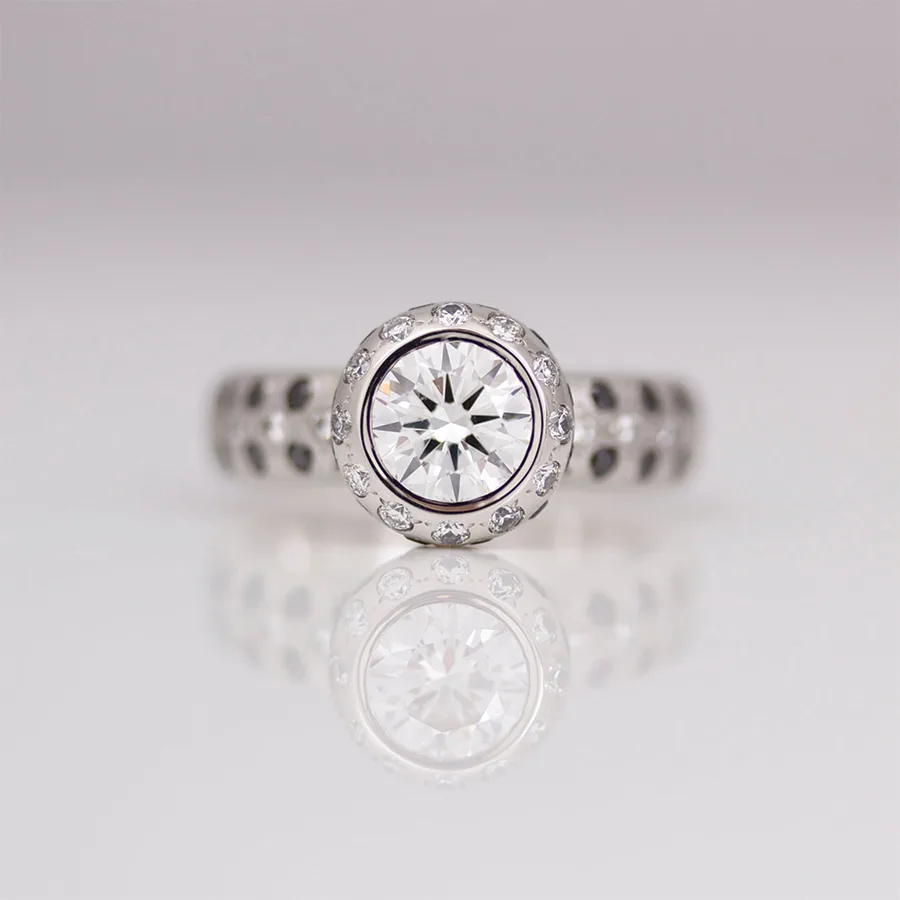
Diamonds, all you need to know (part 2) clarity

Diamond Clarity: Diamonds, all you need to know (part 2) clarity

I have studied diamonds at The Gemological Association of Great Britain (Gem-A), passed their diamond grading exams, and been accredited DGA, (diamond member of the Gem-A) I’ve been buying diamonds for around 40 years, and have seen many hundreds of thousands…good and bad. Diamonds, all you need to know (part 2) clarity

As with the diamond (part 1), this is a brief guide as to why and how diamonds are graded. It is important that if you are buying a diamond, you look at the diamond you are buying, and love the diamond you are buying, rather than put faith in a piece of paper or certificate which isn’t a guarantee but a person (not always impartial) opinion on a specific day.

Diamond and rose gold stacking set
Diamond and rose gold stacking set D VVS1 diamond

The second of the 4 C’s is clarity, how free from flaws.

We grade diamond clarity using a 10x magnification loupe. The highest and most desirable grade is flawless. From there, clarity moves through various grades (shown on the diagram) until flaws become obvious to the naked eye and start to affect the diamond’s durability.

Diamonds with higher clarity grades hold more value and are extremely rare. Lower-clarity diamonds appear less brilliant and, if heavily flawed, can fracture more easily. Like the color scale, clarity grading is non-linear—the differences become much more noticeable as the grade drops.

 The GIA scale is most commonly used and has 6 categories, divided into 11 specific grades.

diamond clarity chart how pure is the diamond, how free from flaws

When grading a diamond’s clarity, we start by examining it with the naked eye.

If flaws are easily visible, the stone falls into the Included (I) category or lower. Next, we use a 10x loupe, stabilizing our hands to minimize movement. We divide the diamond visually into segments—like a clock face—and scan it clockwise from 12 o’clock. The longer it takes to spot flaws, the higher the clarity.

Clarity depends on the number, size, type, and location of inclusions. These may be foreign crystals, tiny internal diamond fragments, or structural imperfections like faint cracks. Inclusions can appear white, cloudy, or dark—black or dark inclusions, especially near the center, affect clarity more than faint ones near the edge.

We group imperfections into internal characteristics (inside the stone) and external characteristics (on the surface). While certificates are useful, it’s essential to look at the diamond in person. Some stones appear dull or cloudy due to micro-inclusions or clouds not visible at 10x magnification but apparent under stronger magnification.

Only about 20% of diamonds mined are clean enough to be used as gemstones.

About 80% of all mined diamonds aren’t clean enough for jewellery and end up in industrial use. Even among the top 20%, many stones have inclusions visible to the naked eye. Diamonds that appear flawless from about six inches away are known as “eye-clean.” Sometimes, inclusions are cleverly hidden beneath the setting in a finished piece.

Some diamonds receive clarity enhancements through fracture filling, a process similar to fixing a crack in a car windscreen. Reputable jewellers always disclose this treatment. Trusted fillers often show a faint flash of colour, typically orange or pink, when viewed closely. 

I’m always happy to show a selection of diamonds to anyone considering a commission. You can’t judge a stone’s beauty by a certificate alone—what matters most is how it looks to you. I bring experience and technical understanding, and I’m here to share that. But in the end, you need to love what I make for you—not just now, but for years to come.

Book an appointment

Save</span>

Save</span>

Save</span>

Save</span></span>

Save</span></span>

GDPR

European Union GDPR (General Data Protection Regulations)

The EU GDPR is designed to help all of us have more control over our personal data, and how is it used.

Who does the information GDPR apply to?

Data subjects, being all visitors and users of any website who are members of the European Union, and therefore who submit personal data. donaldryker.com is the data processor and data controller of this site. You can find out more about this law here.

Privacy Policy

This privacy policy sets out how I, David Ashton use and protect any information that you give when you use this website.

I am committed to ensuring that your privacy is protected. Should I ask you to provide certain information from which you can be identified when using this website, you can be assured that it will only be used in accordance with this privacy statement.

If I change this policy I will update this page. You should check from time to time to ensure that you are happy with any changes. This policy is effective from 22 August 2012.

What I collect

I may collect the following information:

  • your name
  • contact information including email address
  • demographic information such as postcode, preferences and interests
  • other information relevant to customer surveys and/or offers
What I do with the information I gather

I require this information to provide you with a better service and in particular for the following reasons:

  • Internal record keeping.
  • I may use the information to improve our products and services.
  • I may periodically send promotional emails about new products, special offers or other information which I think you may find interesting using the email address which you have provided.
  • From time to time, I may also use your information to contact you for market research purposes. I may contact you by email, phone, fax or mail. I may use the information to customise the website according to your interests.
Security

I am committed to ensuring that your information is secure. In order to prevent unauthorised access or disclosure, I have put in place suitable physical, electronic and managerial procedures to safeguard and secure the information I collect online.

How I use cookies

A cookie is a small file which asks permission to be placed on your computer’s hard drive. Once you agree, the file is added and the cookie helps analyse web traffic or lets you know when you visit a particular site. Cookies allow web applications to respond to you as an individual. The web application can tailor its operations to your needs, likes and dislikes by gathering and remembering information about your preferences.

I use traffic log cookies to identify which pages are being used. This helps me analyse data about web page traffic and improve the website. I only use this information for statistical analysis purposes and then the data is removed from the system.

Overall, cookies help provide you with a better website by monitoring which pages you find useful and which you do not. A cookie in no way gives us access to your computer or any information about you, other than the data you choose to share with us.

You can choose to accept or decline cookies. Most web browsers automatically accept cookies, but you can usually modify your browser setting to decline cookies if you prefer. This may prevent you from taking full advantage of the website.

Links to other websites

My website may contain links to other websites of interest. However, once you have used these links to leave our site, you should note that I do not have any control over that other website. Therefore, I cannot be responsible for the protection and privacy of any information which you provide whilst visiting such sites and such sites are not governed by this privacy statement. You should exercise caution and look at the privacy statement applicable to the website in question.

Controlling your personal information

You may choose to restrict the collection or use of your personal information in the following ways. If you have previously agreed to us using your personal information for direct marketing purposes, you may change your mind at any time by writing or emailing me.

I will not sell, distribute or lease your personal information to third parties unless I have your permission or are required by law to do so. I may use your personal information to send you promotional information about third parties which I think you may find interesting if you tell us that you wish this to happen.

You may request details of personal information which I hold about you under the Data Protection Act 1998. 

If you believe that any information I are holding on you is incorrect or incomplete, please email us as soon as possible.  I will promptly correct any information found to be incorrect.

Google Analytics

User and Event Data Retention

User-level and event-level data associated with Google Analytics cookies is retained for 14 months and then automatically deleted.

IP Anonymization

I have implemented IP Anonymization, simply put, the last three digits of your IP address are set to zeros in memory shortly after being sent to the Analytics Collection Network. The full IP address is never retained, or written to disk.