Diamond, the name coming from the Greek adámas “unbreakable”. Pure crystalline carbon, the hardest natural substance, treasured for centuries due to its rarity and beauty.
One of the oldest and rarest of nature’s treasures you can own are natural diamonds. Formed through intense heat and pressure in the earth’s mantle between 1 billion and 3.5 billion years ago. Undeniably rare and precious with an enduring value, diamonds are a perfect way to mark life’s most precious and enduring moments.
I have only ever, and will only ever, use natural diamonds and natural gemstones, never those man-made in a lab.
Lab-grown diamonds are factory-made, and typically produced in a matter of weeks.
Because they are mass-produced in batches, they are neither rare nor unique. They don’t possess the enduring value of natural diamonds. Lab-grown diamonds may look like natural diamonds, but they have very distinct growth patterns, which enables them to be detected easily by trained gemologist
In terms of monetary value, lab diamonds lose almost all their value the moment they’re purchased.
Add to this the fact that lab diamond prices are consistently getting lower, and you should be prepared to see lab diamonds much cheaper in a year or two.;
On the other hand, due to their rarity, natural diamonds, especially fine quality and fancy colours have consistently increased in value.
Lab diamonds are often sold as being greener and more ethical. In fact on average, producing one polished carat of lab-grown diamond releases 511 kg of greenhouse gases, more than three times that of one polished carat of mined natural diamonds.To put this into perspective, the typical US household produces 48 metric tons (48,000 kg) of greenhouse gases each year
I’m not sure if it’s possible, but I’m going to try to give an insight into the massive subject that is diamonds, first thinking two blogs, I now think maybe three.
Having studied diamonds at the Gemmological Association, passed my DGA (a practical and written examination of two lever arch files of facts and figures.
I’ve been handling and dealing with diamonds for coming up 40 years. My experience and knowledge have taught me that the best thing is to look at diamonds. I have yet to meet someone who says a lower quality diamond looks the same or as beautiful as a fine one, but at what point is the increase in cost worthwhile.
Increasing in the trade, especially online, computer-generated images are used rather than honest unedited photographs.
Many people have a false impression of diamonds. In reality, diamonds are all about science—and there’s a clear reason why higher-quality diamonds look more beautiful.
Diamonds have the advantage of being the hardest gemstone, making them ideal for engagement rings that must withstand daily wear. But the common belief that all diamonds are perfectly clear, white, and sparkling is far from true. Truly colourless and bright diamonds are rare.
Most diamonds on the market appear yellowish or cloudy. They’re often cut to maximize profit, not beauty. A well-cut, high-quality diamond looks stunning because it follows precise proportions that enhance light performance—not just because it’s a diamond.
Higher quality diamonds look brighter and sparkle more, they cost more but look superior, I’d always recommend buying the best quality you can rather than the biggest
The obvious way to break this vast subject down is to the four C’s. This blog will deal with colour, and the next clarity then carat and cut, the way we quantify the quality and therefore the value of a diamond.
choose something you’ll treasure for years to come.
Colour:
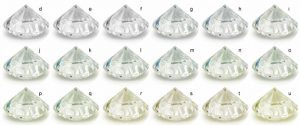
The ideal diamond is colourless or white. Diamonds are graded on a scale from D to Z, with D representing the whitest, most colourless stones. Accurate colour grading can only be done on unset diamonds, viewed through their longest plane with the culet pointing upwards. Most laboratories use a set of master stones to determine the closest colour match.
Yellow tones in diamonds come from nitrogen trapped within the carbon structure—the more nitrogen, the more yellow the diamond appears. Diamonds graded D to G are generally considered colourless, and most people won’t detect any yellow at this level.
Most diamonds show a slight yellow tint. A D-grade diamond appears very pure and icy white. Because of its rarity, it costs significantly more than more commercial grades like J or K. Seeing a D, E, F, or G diamond—especially when set in platinum—makes the price difference easy to understand. By contrast, diamonds graded H, I, or J don’t look obviously yellow, but they don’t appear white either. They often seem slightly off—like they’ve been washed with something yellow—lacking the brightness one expects in a diamond.
Choosing a diamond with good colour is more important than prioritizing clarity. Our eyes pick up colour far more quickly than internal flaws. Spending money to improve clarity while compromising on colour rarely makes sense.
I get a selection of diamonds in for most commissions, generally to a budget.
When I line up a selection of diamonds and ask clients to choose their favorite. They usually pick the whiter ones—often by instinct. They respond to the lack of color without me needing to point out which stone is the whitest.
One trade trick is to set an off-white diamond in yellow gold. The yellow metal helps disguise the diamond’s own yellow tint, making it appear whiter.
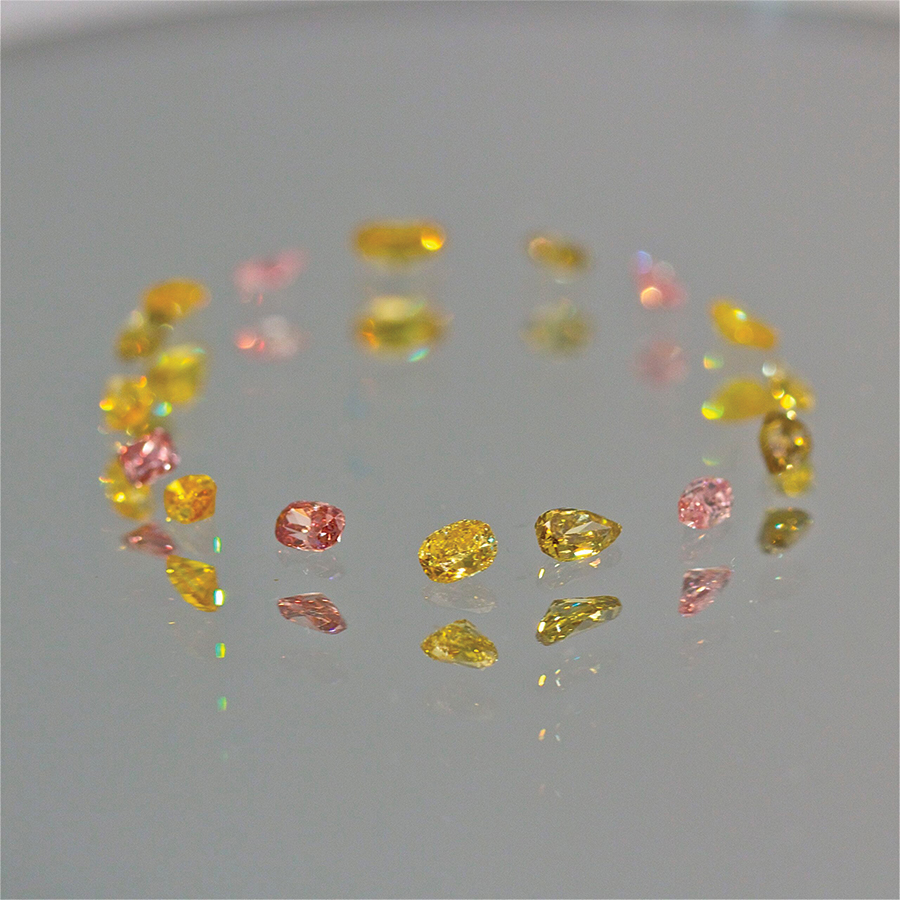
We also see fancy-colored diamonds, which come in almost any shade, with rarity driving their value. Yellow diamonds get their color from nitrogen, bluefrom boron, and pink from plastic deformation.
Discover more about natural fancy diamonds.
It is possible to artificially treat diamonds to change the colour. Treated diamonds are significantly cheaper than natural fancies.
Coloured diamonds are a whole subjectwhich I’ll deal with in another blog, but they are a real passion of mine.
