The third and final instalment on Diamonds, covering carat & cut. Diamonds all you need to know part 3 cut & carat
Diamond Carat:

E
A carat (ct) is a unit of weight, not size. One carat equals 0.2 grams, or a fifth of a gram.
To break it down further, we divide one carat into 100 points—so 50 points equals half a carat.
It’s important to note that carat measures weight, but size depends on density. Different gemstones have different densities. For example, sapphires and rubies are denser than diamonds, so a one-carat ruby or sapphire will be smallerthan a one-carat diamond. On the other hand, emeralds are less dense, so a one-carat emerald will be larger than a diamond of the same weight.
This density difference also helps distinguish diamonds from simulants. Take cubic zirconia (CZ)—it’s denser than diamond. So if you compare two stones with the same diameter, the CZ will weigh more than the diamond.
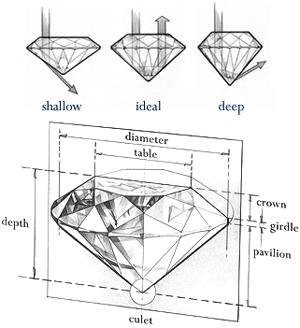
A well-cut stone follows an ideal diameter-to-weight ratio, designed to maximize light performance. This balance helps the stone sparkle more and look more beautiful overall.
Diamonds all you need to know part 3 cut & carat
Diamond Cut: Diamonds all you need to know part 3 cut & carat
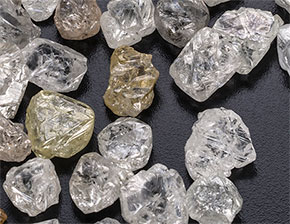
Not just the shape of the diamond, but how accurately it is cut to maximize its beauty. When dealing with such high-value materials, stone cutters don’t think about how beautiful will this diamond be, but how much money will it make. Diamond cutting starts a bit like pattern cutting, trying to maximize the rough. The general rule of thumb is if you double its weight then you quadruple its price. Ideally, you will want to get as few stones as large as possible, rather than many smaller stones.
Round brilliant cuts have been worked out to maximize a diamond’s ability to reflect light. It’s an old Hatton Garden wife’s tale that a diamond needs to be set in claws, so it sparkles, nonsense. If a diamond is cut to the correct proportions, then it has complete internal reflection, the back facets working as a mirror, reflecting all the light out of the top of the stones, for us to wonder at. You can make minor adjustments, to give the stone more rainbow/ dispersion, or sparkle/ brilliance, but a well-cut diamond looks much nicer and appears brighter than a badly cut stone.
The cut is often overlooked as it isn’t as easy to quantify as the colour or clarity. I’ve seen some “interesting” stones generally purchased by a member of the public on holiday, or online. They can be a carat in weight, but have the diameter of a half carat. They are very deep, appearing to have a big dark tunnel in the middle. Or the reverse a half carat looking like a carat, but looking very flat, having very little sparkle. Square stones can be more rhomboidal, and the table and girdle are not parallel. You might think why does that matter, well they simply never look right, I think the cut of a diamond is much more important than any other charastic. I ensure all the diamonds I use, even those 1mm diameter are all well cut, and the overall look is far superior to those who have used lower quality stones. The shape of a stone also alters the way it works with the light. Princess cuts are also known as square brilliants, they always have low large tables, thus very little rainbow dispersion, a baguette or emerald cut is a much older cut, carrying more weight, they don’t have much brilliance but do have amazing dispersion in the right light. Some marquise are long and thin, some shorter and wider, the ideal being 2-1, all having a bow tie effect of faceting in the middle. As I seem to keep saying you need to look at stones, imagining what they look like, or seeing photos or even worse computer-generated images won’t give you a true likeness.
Diamonds look their best under candlelight….or halogen.