Understanding the Rub-over Setting (And Why It Outperforms Claws)

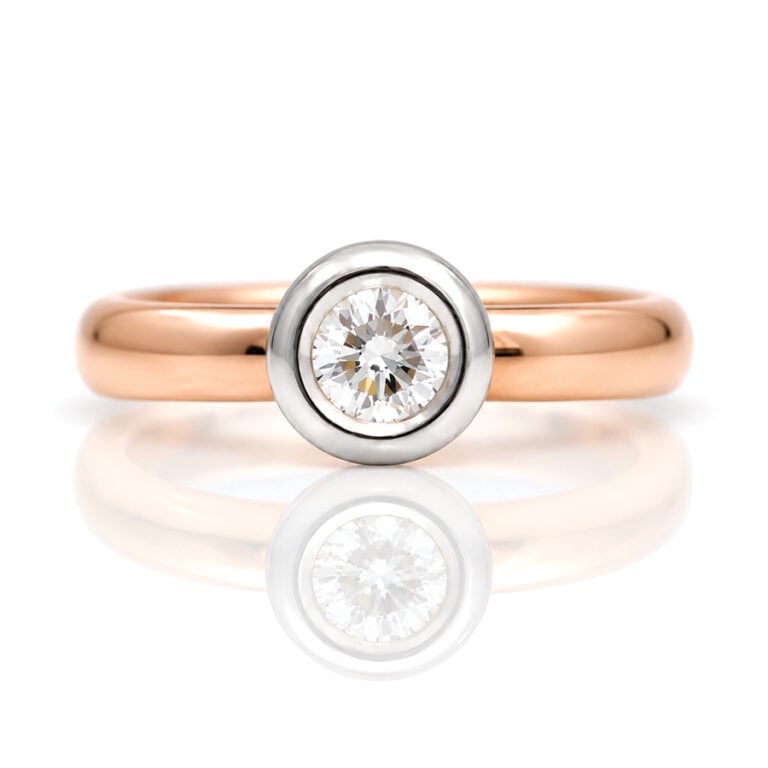
To me, a rub-over setting is the perfect marriage of art and engineering.

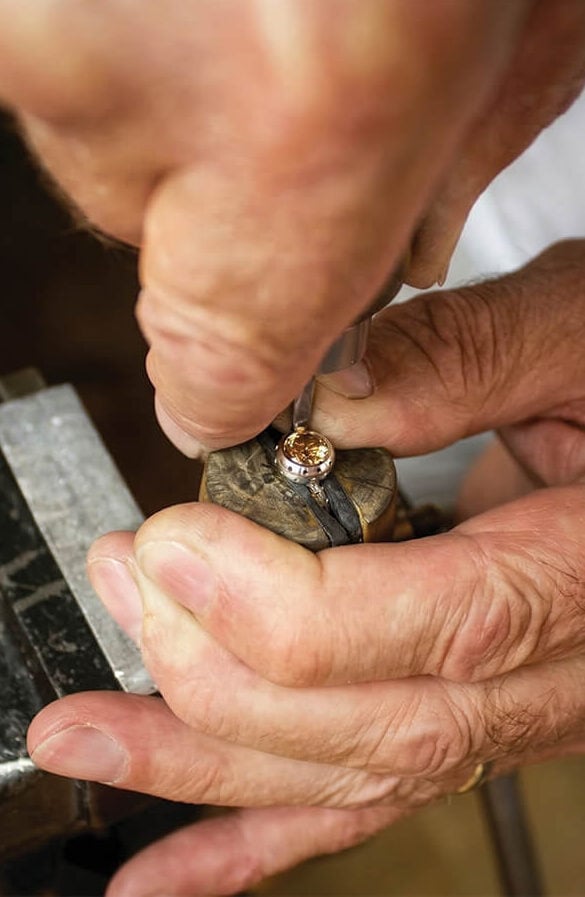
Rather than using fragile claws, I use a lathe to hand-turn a solid, precision-fit wall of precious metal that completely encircles the gemstone.

Using custom tools I designed myself, I meticulously burnish and compress this continuous rim of platinum or 18ct gold just over the stone’s widest edge, holding it securely captive.

The result is an incredibly sleek, fluid design with absolutely no sharp edges to snag on your clothes. It elegantly frames the gem to enhance its visual size, while sealing it safely away from daily knocks and trapped dirt—creating a timeless piece designed to be worn effortlessly and loved every single day
Understanding the Rub-over Setting (And Why It Outperforms Claws)

A rub-over setting is arguably the most practical, durable, and modern way to wear fine jewellery.

Here is exactly why a rub-over setting outperforms claws for everyday wear:

1. Superior Protection for the Gemstone

Claws leave the vulnerable outer edge of a gemstone—the girdle—exposed to knocks. If you accidentally hit a claw-set diamond against a granite countertop or a car door, the stone can easily chip. A rub-over setting wraps that entire edge in solid precious metal, acting like a protective bumper.

2. Zero Snagging or Catching

Claws are notorious for acting like tiny hooks. They catch on winter knitwear, pull threads on delicate silk scarves, and pierce right through latex or winter gloves. Because a rub-over setting is perfectly smooth all the way around, it glides effortlessly over fabrics without a single snag.

3. Maximum Security

If a single claw gets snagged and pulls backward, the gemstone becomes loose and can easily fall out. A rub-over setting uses a continuous wall of metal burnished tightly over the stone. There are no individual parts to catch or bend out of shape, making it incredibly secure.

4. It Stays Cleaner, Longer

Claw settings have open gaps underneath and around the sides. Hand cream, soap, oil, and dead skin quickly build up in these cavities, blocking light and making the diamond look dull. A rub-over setting seals the perimeter of the stone, preventing dirt from getting trapped underneath so your gem keeps its sparkle.

5. An Illusion of Size

Because the solid band of highly polished platinum or gold frames the diamond, it blends visually with the stone. This often creates an optical illusion, making the diamond look significantly larger than it would if it were held by thin, isolated claws.

A Note on Craftsmanship: While a rub-over setting has massive benefits for the wearer, it is much harder for the jeweller to create. Claw settings are relatively forgiving, but a rub-over setting requires absolute mathematical precision. The metal bezel must be turned and burnished over the stone with completely uniform pressure to avoid crushing the gem while ensuring a seamless, smooth finish.

Understanding the Rub-over Setting (And Why It Outperforms Claws)

GDPR

European Union GDPR (General Data Protection Regulations)

The EU GDPR is designed to help all of us have more control over our personal data, and how is it used.

Who does the information GDPR apply to?

Data subjects, being all visitors and users of any website who are members of the European Union, and therefore who submit personal data. donaldryker.com is the data processor and data controller of this site. You can find out more about this law here.

Privacy Policy

This privacy policy sets out how I, David Ashton use and protect any information that you give when you use this website.

I am committed to ensuring that your privacy is protected. Should I ask you to provide certain information from which you can be identified when using this website, you can be assured that it will only be used in accordance with this privacy statement.

If I change this policy I will update this page. You should check from time to time to ensure that you are happy with any changes. This policy is effective from 22 August 2012.

What I collect

I may collect the following information:

  • your name
  • contact information including email address
  • demographic information such as postcode, preferences and interests
  • other information relevant to customer surveys and/or offers
What I do with the information I gather

I require this information to provide you with a better service and in particular for the following reasons:

  • Internal record keeping.
  • I may use the information to improve our products and services.
  • I may periodically send promotional emails about new products, special offers or other information which I think you may find interesting using the email address which you have provided.
  • From time to time, I may also use your information to contact you for market research purposes. I may contact you by email, phone, fax or mail. I may use the information to customise the website according to your interests.
Security

I am committed to ensuring that your information is secure. In order to prevent unauthorised access or disclosure, I have put in place suitable physical, electronic and managerial procedures to safeguard and secure the information I collect online.

How I use cookies

A cookie is a small file which asks permission to be placed on your computer’s hard drive. Once you agree, the file is added and the cookie helps analyse web traffic or lets you know when you visit a particular site. Cookies allow web applications to respond to you as an individual. The web application can tailor its operations to your needs, likes and dislikes by gathering and remembering information about your preferences.

I use traffic log cookies to identify which pages are being used. This helps me analyse data about web page traffic and improve the website. I only use this information for statistical analysis purposes and then the data is removed from the system.

Overall, cookies help provide you with a better website by monitoring which pages you find useful and which you do not. A cookie in no way gives us access to your computer or any information about you, other than the data you choose to share with us.

You can choose to accept or decline cookies. Most web browsers automatically accept cookies, but you can usually modify your browser setting to decline cookies if you prefer. This may prevent you from taking full advantage of the website.

Links to other websites

My website may contain links to other websites of interest. However, once you have used these links to leave our site, you should note that I do not have any control over that other website. Therefore, I cannot be responsible for the protection and privacy of any information which you provide whilst visiting such sites and such sites are not governed by this privacy statement. You should exercise caution and look at the privacy statement applicable to the website in question.

Controlling your personal information

You may choose to restrict the collection or use of your personal information in the following ways. If you have previously agreed to us using your personal information for direct marketing purposes, you may change your mind at any time by writing or emailing me.

I will not sell, distribute or lease your personal information to third parties unless I have your permission or are required by law to do so. I may use your personal information to send you promotional information about third parties which I think you may find interesting if you tell us that you wish this to happen.

You may request details of personal information which I hold about you under the Data Protection Act 1998. 

If you believe that any information I are holding on you is incorrect or incomplete, please email us as soon as possible.  I will promptly correct any information found to be incorrect.

Google Analytics

User and Event Data Retention

User-level and event-level data associated with Google Analytics cookies is retained for 14 months and then automatically deleted.

IP Anonymization

I have implemented IP Anonymization, simply put, the last three digits of your IP address are set to zeros in memory shortly after being sent to the Analytics Collection Network. The full IP address is never retained, or written to disk.